Commercial Concrete Flatwork
in Middle Tennessee
Heavy-duty flat slab work for commercial buildings: warehouse and distribution floors, retail and showroom slabs, plaza paving, exterior sidewalks. Engineered flatness, joint design, surface hardeners, and the finish your spec calls for.
Request a QuoteCommercial Slabs Built to FF/FL
Commercial concrete flatwork is engineered concrete. Warehouse floors carry rack loads measured in tens of thousands of pounds per leg and lift trucks running tight aisles at speed. Retail slabs carry distributed live loads, point loads under fixtures, and the kind of constant foot and cart traffic that exposes any surface defect within a year. Plaza paving carries crowds, food trucks, equipment delivery, and weather. Each of these surfaces has a specification (flatness, levelness, mix design, joint pattern, surface treatment, durability) and meeting that specification is the entire job. S and S Excavation and Hauling installs commercial concrete flatwork for general contractors, developers, and building owners across Manchester, Murfreesboro, Shelbyville, and the surrounding region.
The headline difference between commercial flatwork and general slab pours is FF/FL, the floor flatness and floor levelness numbers from ASTM E1155. Warehouse and distribution floors with high-bay racking and turret trucks need very tight FF/FL because rack stability and forklift mast vibration depend on it. Retail floors specify lower FF/FL but tighter cosmetic tolerance because the surface will be exposed and finished. We measure, document, and meet the spec on every project, and we plan formwork, screed sequence, and finishing crew size around the FF/FL target before pour day.
Surface treatment is the other defining feature. Plain trowel finish is the baseline. Dry-shake hardener applied during finishing dramatically improves abrasion resistance and impact strength for heavy traffic floors. Polished concrete creates a low-maintenance, high-light-reflectance finish for retail and showroom space. Sealer and densifier extend service life on exterior plaza concrete. Joint sealants and armor joints are specified at high-traffic transitions to prevent edge spalling under wheel load. We coordinate the specified surface system from mix design through final cure.
Commercial Flatwork Scope
Warehouse and Distribution Floors
Slab-on-grade for warehouse, distribution, and light-industrial buildings. Engineered subbase, vapor barrier, welded wire or post-tensioned reinforcement, and concrete placed to FF/FL targets matched to the racking and lift-truck specification. Dry-shake hardener applied where the design calls for abrasion resistance.
Retail and Showroom Slabs
Floor slabs for retail stores, showrooms, and commercial occupancy with cosmetic surface requirements. Tight tolerance on flatness and surface defects because the slab will be polished, sealed, or covered with thin-set tile or LVT. Joint pattern coordinated with the architect for visible surfaces.
Plaza Paving and Exterior Hardscape
Plaza-style exterior concrete at building entries, courtyards, and pedestrian zones. Standard troweled finishes, broom finishes for slip resistance, exposed aggregate panels for design accent, and integral color where the master plan calls for it. Slope, jointing, and drainage detailed to keep water moving off the slab.
Sidewalks and Walkways
Commercial sidewalk runs along the right-of-way and across the site. Standard public works sections, ADA-compliant cross-slope and joint placement, detectable warning panels at curb cuts. Replacement sidewalk where existing concrete has settled, cracked, or failed accessibility audits.
Polished and Hardened Floors
Exposed-finish concrete floors specified for polishing or surface densification. Flatwork crews coordinate with the polishing subcontractor to deliver a floor that is ready for the polishing process, flat enough, free of low-strength surface defects, and with joint placement that suits the polished finish. Densifiers and stains applied per the project spec.
Joint Sealants and Armor Joints
Construction joints, control joints, and isolation joints filled with semi-rigid joint sealant per the project spec, typically after the initial 60 to 90 day cure. Armor joints (steel-edged construction joints) installed at high-traffic transitions where wheel loads would otherwise spall ordinary concrete edges. Coordinated with the grading and underslab utilities scope.
Our Commercial Flatwork Process
Spec Review and Bid
We review the structural drawings, floor flatness specification, mix design, joint plan, and surface treatment requirements. The bid breaks out subgrade, vapor barrier, reinforcement, concrete supply, placement, finishing, surface hardener, and joint sealant as line items so the GC knows exactly what is included.
Subbase and Vapor Barrier
Engineered subbase is installed and compacted to the specified depth and density. Vapor retarder or vapor barrier is laid per the architectural detail at slabs requiring moisture protection. Underslab utilities, embeds, and dowels are coordinated with the other trades and verified before pour day.
Reinforce, Pour, Screed
Reinforcement is placed per the structural drawings. On pour day, concrete is placed, vibrated, and screeded with the equipment matched to the FF/FL target, laser screed for tight tolerance work, vibratory screed for standard slabs. Crew size is sized for the placement rate and the finishing window.
Finish, Cure, Joint, Document
Surface hardener (where specified) is broadcast and worked in. Power trowels finish the surface to the required tolerance and texture. Saw-cut joints are placed within the early-entry window. Curing compound or wet cure is applied. FF/FL measurements are taken and documented for the project file before turnover.
Commercial Flatwork Projects

Why Choose S and S for Commercial Flatwork
FF/FL Discipline
Floor flatness is measured, documented, and met. We size crew, equipment, and pour rate around the FF/FL target before the truck shows up. The numbers go into the project file with every pour, not hoped for after the fact.
Subbase Done Right
Most slab failures and most flatness misses trace back to subbase preparation, not the pour. We come from earthwork. Compacted base, verified moisture, and confirmed elevation are non-negotiable steps before any concrete arrives on site.
Plans-and-Spec Discipline
Mix designs, reinforcement schedules, joint plans, and finish requirements come from the documents. Field improvisation only happens when the structural engineer signs off. The job that gets built is the job that was designed.
GC Schedule Friendly
We work to the project CPM, communicate scope conflicts early, coordinate with underslab MEP and the building shell team, and turn over completed slabs ready for the next trade. Schedule discipline is part of how we work, not a stretch goal.
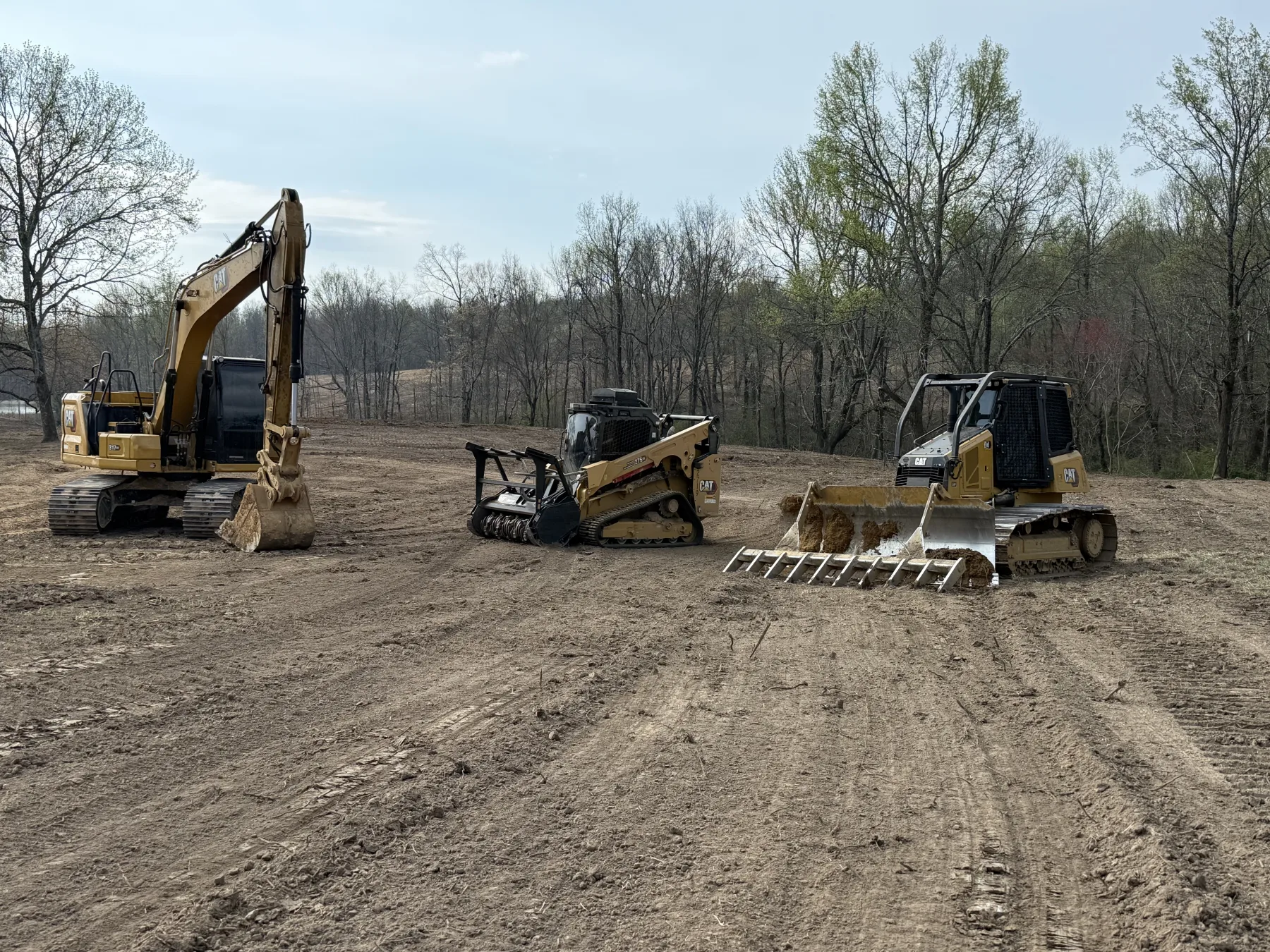
One Crew, Earth to Finish
Excavation, base prep, formwork, reinforcement, pour, and finish are all the same crew. No coordination gap, no finger-pointing, no scheduling delay between trades. One contract, one accountable party, one schedule for the entire flatwork scope.
Documented Turnover
Concrete supplier tickets, FF/FL measurement reports, surface hardener product data, joint layout drawings, and inspection sign-offs are organized and handed over at project closeout. The owner gets a complete file for facilities and warranty reference.
Commercial Flatwork FAQs
What FF/FL numbers can you hit on a warehouse floor?
For standard warehouse and distribution floors, we routinely hit FF35/FL25 or better with conventional vibratory screed methods. For tighter targets such as FF50/FL35 or higher, we use laser screed equipment and modify crew size and finishing sequence accordingly. The target FF/FL drives equipment selection and pricing, so the spec needs to be confirmed before the bid is finalized.
Do you apply dry-shake surface hardener?
Yes. Dry-shake hardener is broadcast onto the fresh concrete surface and worked in during finishing. It improves abrasion resistance, impact strength, and surface durability for heavy traffic floors such as warehouses, distribution centers, and manufacturing space. We coordinate the application rate, color (where applicable), and curing requirements with the spec.
Can your slabs be polished after the cure?
Yes, our slabs are routinely turned over to polishing subcontractors. We coordinate with the polishing crew on flatness target, surface treatment compatibility, joint placement, and curing method so the slab is ready for grinding when the polisher arrives. Polished concrete depends on a flat, defect-free, fully cured slab and our placement methods are designed around that requirement.
How do you handle joint sealing?
Saw-cut control joints get a semi-rigid joint sealant after the initial 60 to 90 day shrinkage period, per the project spec. Sealant is mixed and placed per the manufacturer instructions, with backer rod where the joint depth requires it. For high-traffic floors, armor joints (steel-edged construction joints) are installed during the pour at locations where wheel loads cross the joint repeatedly.
How big a single pour can you handle?
We routinely place pours from a few hundred square feet up to thirty or forty thousand square feet in a single placement event, depending on equipment, crew size, and concrete supplier capacity. Larger pours are sequenced into placement areas with construction joints planned around the daily production rate. Call (931) 636-7713 to discuss pour sequencing on larger scopes.
Do you provide FF/FL measurement reports?
Yes. FF/FL measurements are taken with a calibrated profileograph or equivalent equipment within 72 hours of the pour, per ASTM E1155. The measurement report is included in the project file and turned over with the closeout package, providing documented proof that the slab meets the specification.
Have a Commercial Flatwork Bid
From warehouse and distribution floors to retail slabs, plaza paving, and polished-finish exposed concrete, S and S Excavation delivers commercial flatwork across Middle Tennessee. FF/FL discipline. Subbase done right. Documented turnover.