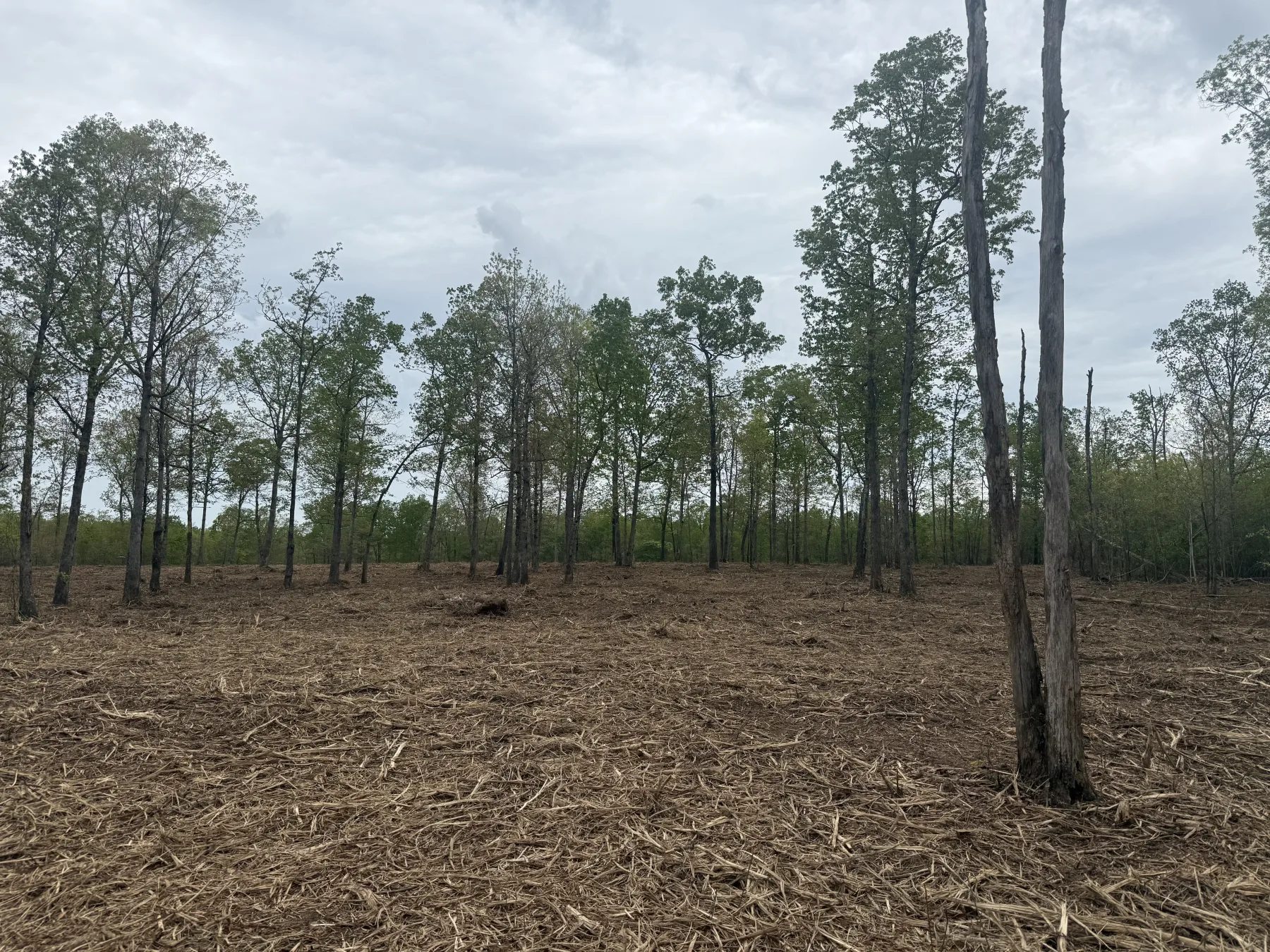
On a wooded lot, the biggest single lever on both the bill and the calendar is not how many trees come down. It is what happens to the wood afterward. Grinding it where it stands and hauling it off a truckload at a time are two completely different jobs wearing the same name.
Somebody calls about a wooded acre out toward Hillsboro and asks what clearing runs. Before anybody can answer that honestly, there is a question that has to go back the other direction: what do you want done with the wood? Because a stand of timber is a volume of material, and that material has to end up somewhere. It can stay on your ground as chips, or it can ride off on a truck. Those two answers produce different schedules, different machines, different ground conditions when we leave, and different numbers at the bottom of the page. Everything else about a clearing job is downstream of that one call.
Two Ways the Same Acre Gets Cleared
Grinding in place means a machine with a cutting head works through the standing growth and reduces it to chips on the spot. Nothing gets stacked, nothing gets loaded, and no truck leaves your property carrying anything. When the machine is done the wood is still there. It is just lying flat in a layer a few inches deep instead of standing up in your way.
Hauling off means the opposite. Material gets cut, dragged into piles, loaded into a truck, driven somewhere that will take it, and dumped. You are paying for the loading, the drive, the dump fee, and the drive back, and then you are paying for it again on the next load. What you get in exchange is bare dirt with nothing on it.
What You Are Doing Next Decides It
The cleanest way to sort this out is to skip the wood entirely and think about the end use. Ground that is going back to pasture, ground that will get bush hogged twice a year, ground that is being opened for sightlines or trails or a food plot: all of that wants the chips left. The mat is doing something useful lying there. It holds the dirt down through a spring storm, it keeps a certain amount of weed seed from taking hold in open soil, and it breaks down into the ground over the following few seasons. You paid for that material when you paid for the machine time. Leaving it is free.
Ground that is about to have concrete on it wants none of that. A slab, a footing, a stone driveway base, anything that gets built and has to stay put, needs to sit on soil rather than on a layer of decomposing chips. Organic material rots, and rotting material loses volume, and volume lost underneath a structure is settlement. So on a build footprint, the wood leaves. That is not a preference, it is what the pour requires.
When There Is Real Wood in It
On a tract carrying decent sawlogs, there is a third option worth raising before anything gets ground up. Good timber can be decked at the edge of the property for you to sell or have milled, and only the tops and the junk get handled as debris. Once it goes through a cutting head that decision is made permanently, so it has to come up at the walk.
How the Schedule Changes
The calendar difference is bigger than most owners expect. When wood is being ground in place, the machine is the whole operation. It works until the ground is done and then it goes home. There is no second vehicle, no waiting on a truck to come back from a dump run, and no dependency on anybody else’s schedule.
Hauling puts a cycle into the job. Load, drive, dump, drive back, load again. While a truck is gone, the machine is either stacking ahead of it or sitting. The number of trips is what sets the length of the job, and the number of trips depends on how much material came off the ground and how far away the disposal site is. On a rural property with a long drive out to a paved road, that cycle time stretches.
What the Ground Looks Like Afterward
Walk a mulched job the week after and you are standing on a soft brown layer with stems visible in it. It looks rough for a season and then it settles and darkens. The topsoil under it never got disturbed, which is worth more than it sounds on a piece of Highland Rim ground where the good dirt is not very deep to begin with.
Walk a hauled job and you are standing on open soil with nothing holding it. That is exactly right if a pad is going in next week. It is a liability if nothing is going to happen for four months and a wet Tennessee spring is coming. Bare ground on any kind of slope moves in a hard rain, and what moves is the layer you most wanted to keep. If the schedule between clearing and building has a gap in it, that gap needs a plan.
The Stump Question Sits Underneath Both
Stumps get decided separately, and shallow rock is what usually decides them. A stump growing in deep soil can be pulled with the root ball attached. A stump sitting on limestone has nothing to lift out of, so it gets cut and ground flush instead. That comes up on a lot of ground out this way, and it is one more reason a number quoted over the phone without a walk is a number somebody is guessing at.
How We Actually Settle It With You
The walk is where this gets decided, standing on the property, not on the phone. We look at what is growing, how thick the stems run, where the drive comes in, and what you have in mind for the ground. Then we tell you what each approach costs you in time and in money and which one we would pick if it were our place.
Either way you hear it from the person who will be sitting in the machine. This is a veteran-owned outfit run out of Manchester, and Hillsboro is a short pull down the road, not a mobilization from another county. You get a real price from the owner after somebody has looked at your ground. If you want more detail on the grinding side, the forestry mulching page for this area covers how the head works and where its limits are. For the full-removal version, see land clearing around Hillsboro.
Questions That Come Up on This One
Is grinding in place always cheaper than hauling?
On the same acre with the same growth, usually yes, because you are not paying for loading, trucking, and disposal. But the two are not interchangeable, so cheaper is only the right frame when both would actually work for what you are doing. Paying to haul a build footprint is not overspending, it is buying the right ground condition.
How thick does the chip layer end up?
It depends entirely on how much material was standing there. Thick undergrowth produces a deep mat, a lightly wooded lot produces a thin one. If you want an even finished surface you can mow, that takes extra passes over the same ground, which is worth doing near the house and rarely worth doing on the back of a tract.
Can I have the chips piled up instead of spread out?
The head throws material as it cuts, so spreading is what it does naturally. Gathering it into a pile afterward is a separate operation with a different machine and it costs like one. If you want mulch stockpiled for beds or trails, say so at the walk so we can plan for it rather than push chips around later.
Will the mulch layer stop grass from growing when I seed later?
A heavy mat will slow a seeding down, which is one reason it matters what the ground is for. On a spot you intend to seed soon, we can work it thinner or pull it back. On ground that has a year before anybody plants anything, the layer will have broken down considerably by then and the soil underneath is better for it.
What if I change my mind after the machine is already out there?
Tell us while it is still on the property. Switching from grinding to hauling partway through means bringing in a truck and picking material back up, which is more work than doing it that way from the start. It is doable, it just costs what it costs. This is the reason the walk happens before anything runs.
Wooded Ground Out Toward Hillsboro?
Tell us roughly how much is standing and what you want the ground doing afterward. We will come look at it and give you both numbers so you can pick with the real figures in front of you. Veteran-owned, based in Manchester.
Get a Free Price Call Now: (931) 636-7713